Centre de Biotechnologie de Borj-Cédria

Flag Tunisia
République Tunisienne | Ministère de l’Enseignement Supérieur et de la Recherche Scientifique
CBBC-Logo-removebg-preview

Centre de Biotechnologie de Borj-Cédria

Recherche Innovation Développement durable

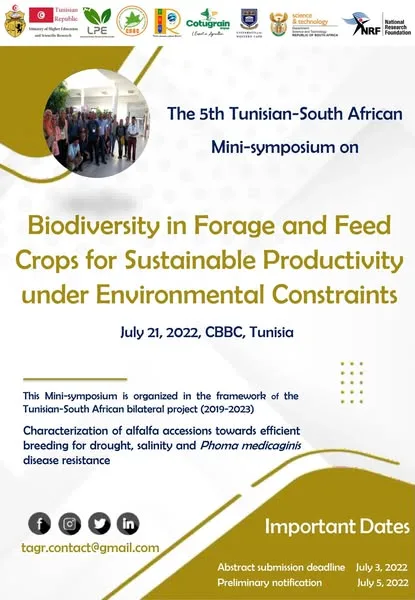
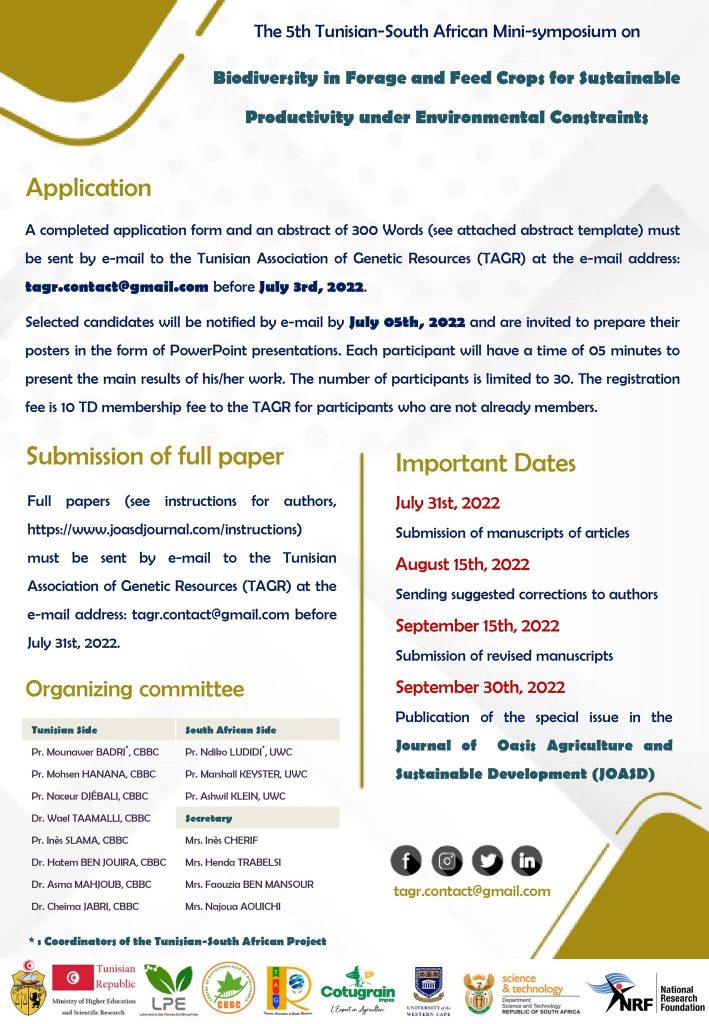
The 5th Tunisian-South African Mini-symposium on  » Biodiversity in Forage and Feed Crops for Sustainable Productivity under Environmental Constraints « 

  • Appel à candidature
  • Appel d'Offres/Consultations
  • Ateliers pratiques
  • Evènements
  • Formations
  • FoWRSaP
  • LPMP
  • Médias
  • Meetings
  • OLIWA Project
  • Partenariat
  • prf2023-d4p1
  • Production Scientifique
  • Publications Scientifiques
  • Tunisian-South African bilateral project
  • Workshop / Séminaires
    •   Back
    • Visites
    • Foires / Journées scientifiques
    • Accompagnement sur terrain
    •   Back
    • P2ES
    •   Back
    • Workshop feedback
he 5th Tunisian-South African Mini-symposium on " Biodiversity in Forage and Feed Crops for Sustainable Productivity under Environmental Constraints "

21 juillet 2022-

Aiming at improving the productivity of alfalfa under combined stresses in both countries, the Centre of Biotechnology of Borj Cedria (CBBC) in Tunisia and the Plant Stress Group at the University of the Western Cape (UWC) in South Africa in collaboration with the Tunisian seed company COTUGRAIN Impex and the South African National Lucerne Trust (NLT), are collaborating in the framework of the Tunisian-South African project (2019-2023) entitled "Characterization of alfalfa accessions towards efficient breeding for drought, salinity and Phoma medicaginis disease resistance".
289368217 390669153094964 2137165226429152540 N
289427627 390669156428297 2014077160915985577 N 709x1024
Alfalfa, known in Tunisia and South Africa as lucerne, is the most widely cultivated forage legume and is regarded as the most desirable crop for this purpose because of its good nutrient profile for livestock and its ability to enrich soil through biological nitrogen fixation. Despite these desirable characteristics, alfalfa is mainly grown under irrigation. Apart from the impact of irrigation on limited water resources which may be from saline environments, increased incidence of droughts in semi-arid and arid environments in Tunisia and South Africa (both are water-scarce countries) has severe impact on alfalfa yield.
 
Compounding the challenges presented by drought and salinity is the occurrence of plant pathogenic microorganisms that cause disease to plants. An important pathogen of alfalfa is Phoma medicaginis. This fungal pathogen causes spring black stem and leaf spot disease in alfalfa, which is one of the most devastating diseases of alfalfa.
Aiming at improving the productivity of alfalfa under combined stresses in both countries, the Centre of Biotechnology of Borj Cedria (CBBC) in Tunisia and the Plant Stress Group at the University of the Western Cape (UWC) in South Africa in collaboration with the Tunisian seed company COTUGRAIN Impex and the South African National Lucerne Trust (NLT), are collaborating in the framework of the Tunisian-South African project (2019-2023) entitled « Characterization of alfalfa accessions towards efficient breeding for drought, salinity and Phoma medicaginis disease resistance ». To do this, an integrated approach using plant genetics and genomics and a consortium of endophytic bacteria was adopted. This project is coordinated by Prof. Mounawer Badri and Prof. Ndiko Ludidi from Tunisian and South African sides, respectively.
289026213 391216283040251 788026954321812243 N
286667903 391216296373583 8349024835060352107 N 724x1024
289089542 391216273040252 3538920433249225574 N 724x1024
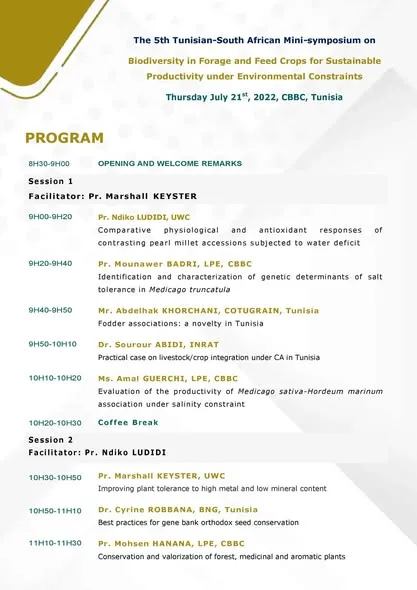
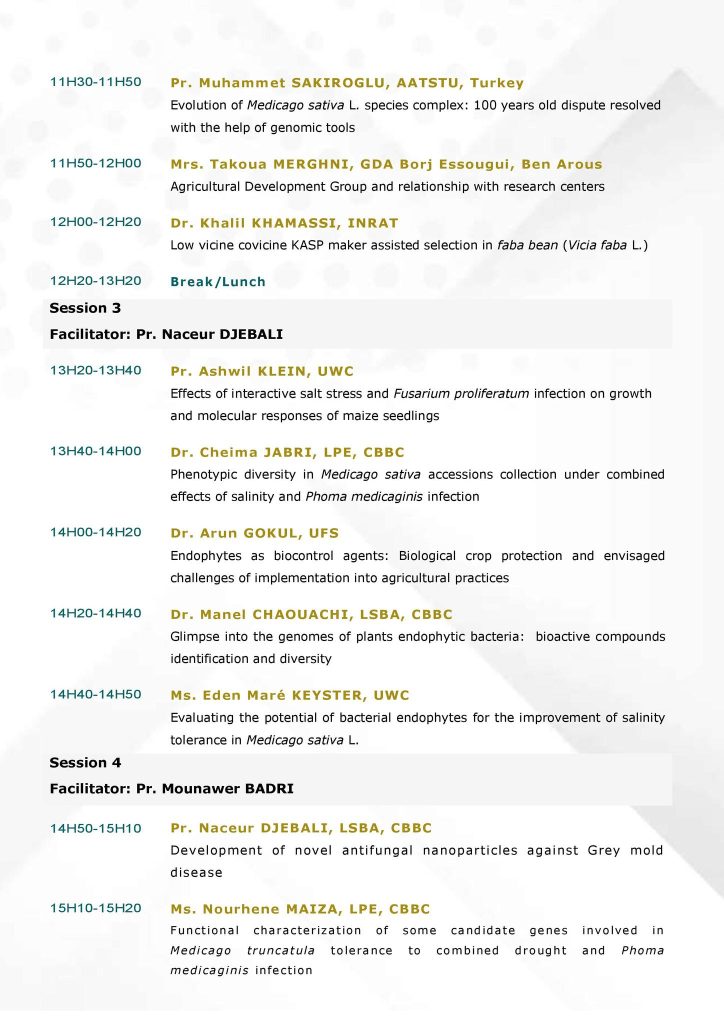
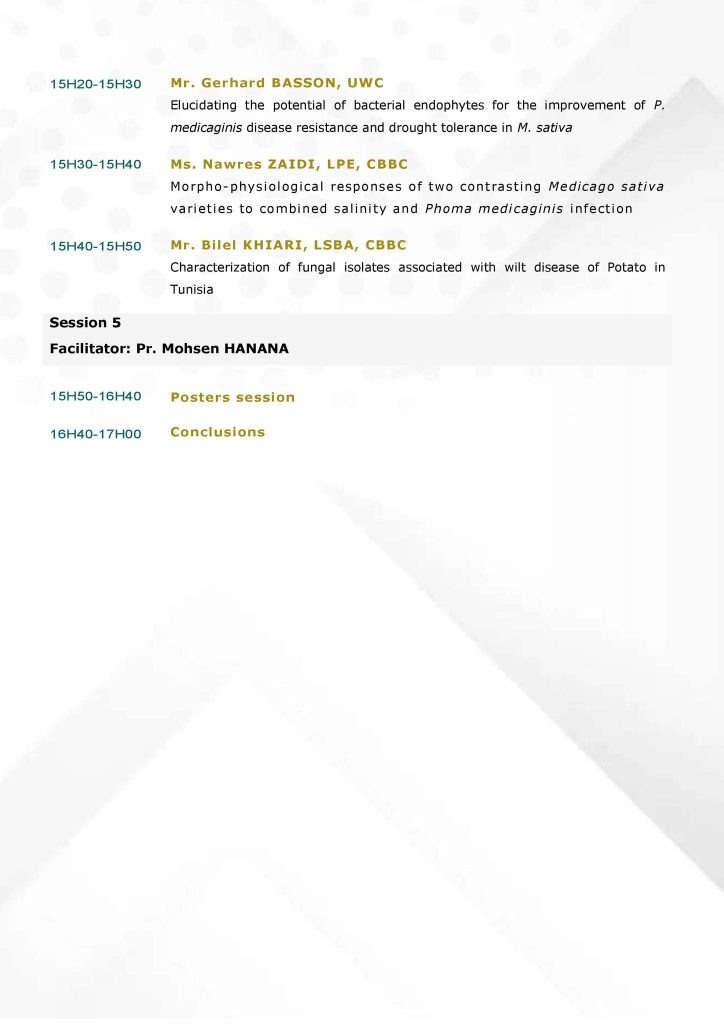
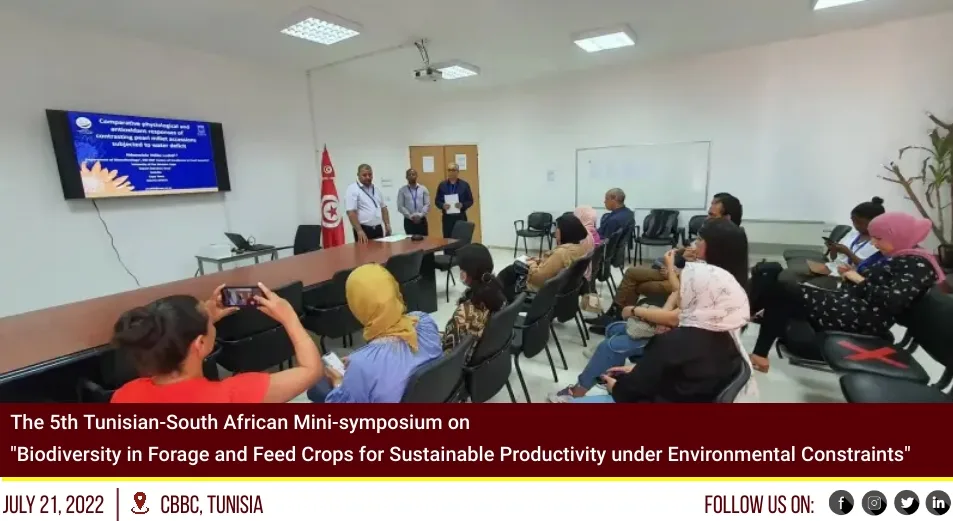
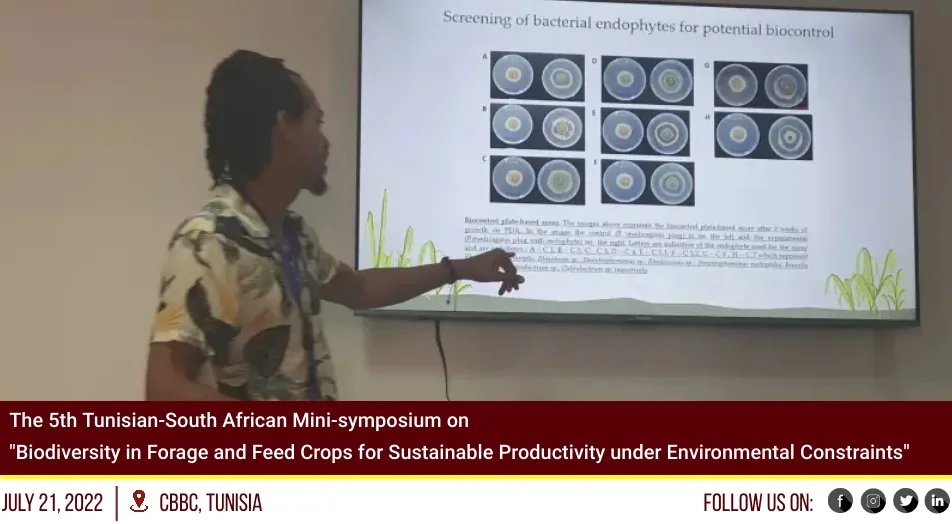
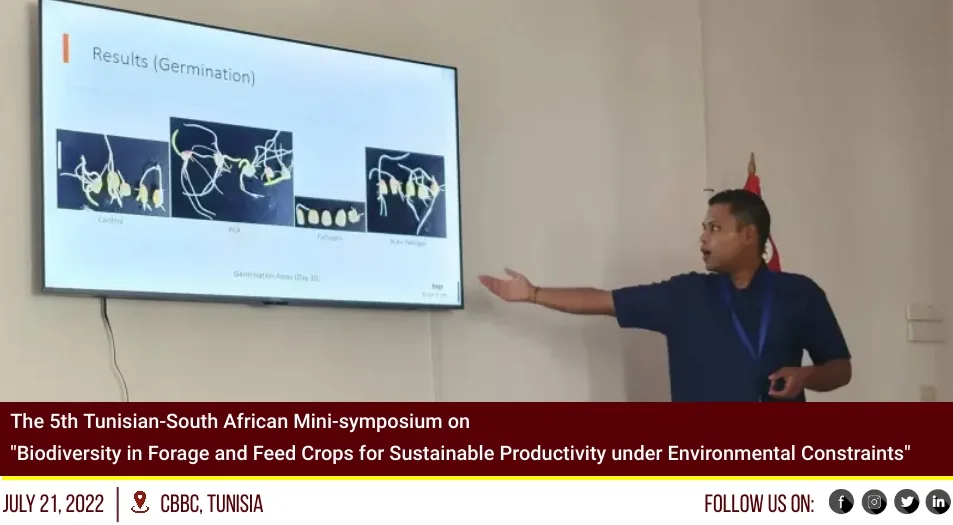
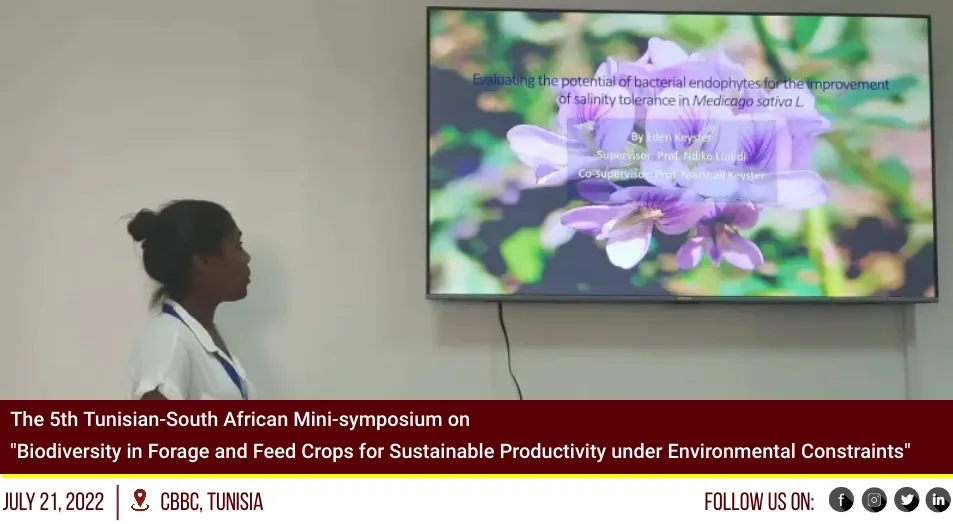
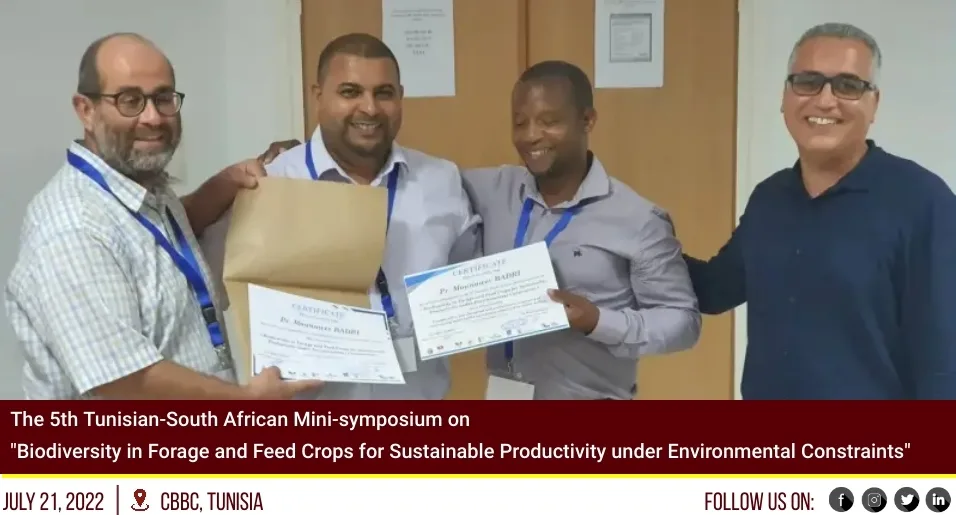
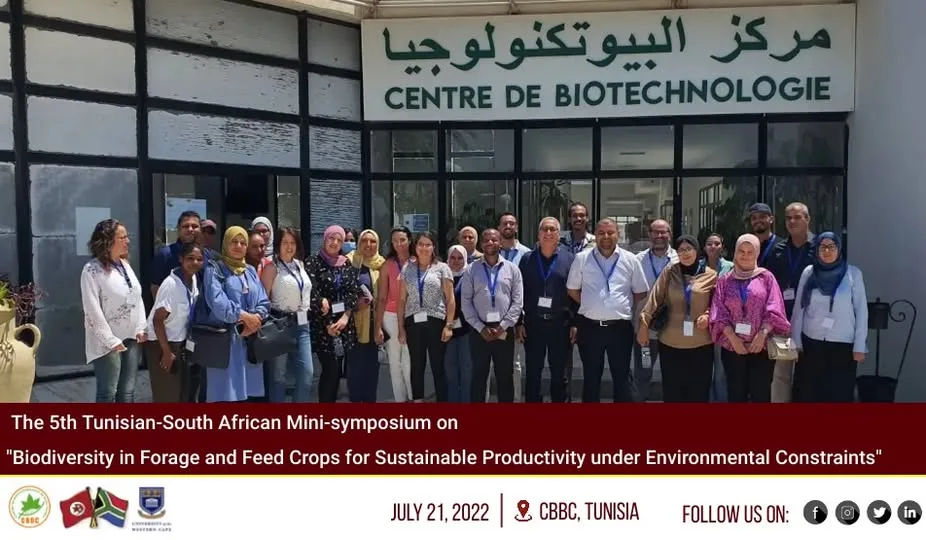
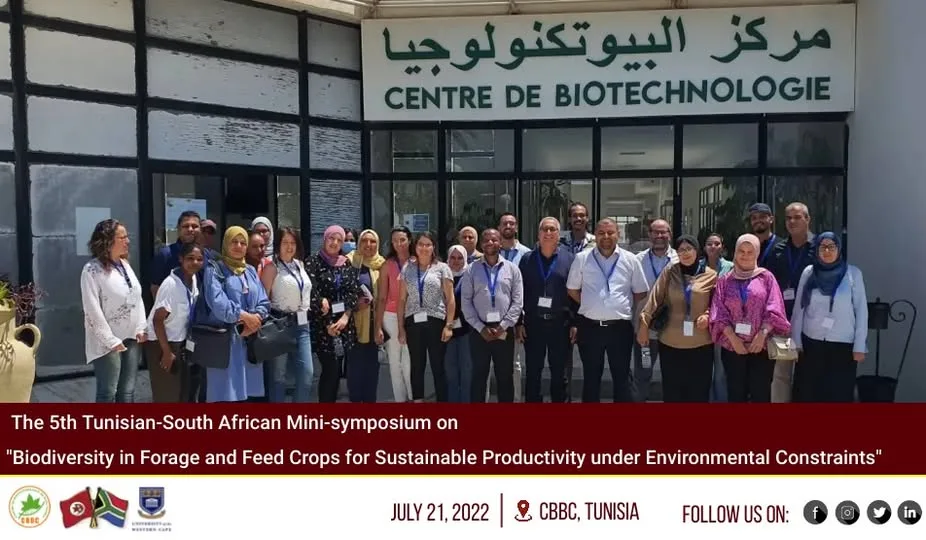
In the framework of this project, the Laboratory of Extremophile Plants (LPE) in CBBC and the Plant Stress Group in UWC in collaboration with the Tunisian Association of Genetic Resources (TAGR) organized the 5th Tunisian-South African Mini-symposium on  » Biodiversity in Forage and Feed Crops for Sustainable Productivity under Environmental Constraints  » which was held on July 21st, 2022 at the CBBC. A total of 40 attendees from the academic sector from four countries including SouthAfrica, Algeria, Turkey and Tunisia as well as members of non-governmental organizations (NGOS), and socio-economic partners participated in the Tunisian-South African Mini-symposium.
In the Mini-symposium, 15 plenary presentations by eminent experts, 6 oral presentations and 10 posters were presented. These presentations revolve around 3 themes:
Diversity of responses to abiotic and biotic stresses in fodder and feed crops,
Identification and characterization of genetic determinants for tolerance to environmental constraints,
Utilization of culture practices and biofertilizers for plant improvement under abiotic and biotic stresses.